


What Happens to Cremated Remains Thereafter?
When a New York funeral home closed its door a few years ago, it found itself in the midst of a moral dilemma it had never bargained for. There, on its shelves, were more than 275 boxes of cremains never picked up by the families of the deceased. Some dated back 100 years.
Legally, it was not required to do anything, but the owners instead decided to try to track down the families. Many did not respond. In the end, a crypt was purchased to be the final resting place of the abandoned boxes.
The story serves as a pointed reminder of what every funeral director has witnessed: families often view cremation as a final disposition, like burial or entombment. It is not, and that means some important decisions must be made. Unfortunately, families often put off deciding what to do with the cremated remains or don’t give the disposition enough serious thought.
With the rate of cremation growing exponentially – in some areas, cremation has surpassed that of traditional burial – the issue has become even more pertinent.
Cremated remains should be treated with the same reverence as one would a body, yet they are often treated carelessly, or as an afterthought. Stories abound about cremains being found in a closet or attic after someone has moved and being returned to the crematory or funeral home of record.
The Decision to Scatter
Of course, many people get caught up in the inevitable Hollywood solution: scattering Uncle Harry’s ashes at the local beach or the racetrack where he blew his money or that favorite park near his house. What Hollywood doesn’t show is the regret that sometimes follows for families.
Because of the irreversible nature of scattering, it is not something to be chosen lightly. The process cannot be undone. What’s more, while many request their cremains be scattered in a favorite place, some of those requests are impractical. Chances are, your relatives will never make a trip to Mount Everest.
Some years back, I handled the funerals of close family friends. Both chose to be cremated, although they had purchased graves in a local Catholic cemetery. Their son, John, chose a companion urn for his parents and kept it in his home.
When he moved to Florida, he recalled his parents’ love of the beach and scattered their ashes, a decision he now regrets. It meant that there was no place to really go and honor their memory.
“My father was a veteran. I could have had [their cremains] buried in the nearby national cemetery,” he said.
Others find it hard to put into place the wishes of the deceased.
Village Chapels, a funeral home in Middle Village, New York, was honored to handle the funeral of the wife of one of their pallbearers. The 75-year-old woman was cremated with the intent to split her cremated remains in two. One half was to be buried in the family plot in a Catholic cemetery, and the other half scattered in Oregon, where the deceased was originally from.
However, after speaking with his priest one Sunday after Mass, and learning the church’s position, the woman’s husband, a practicing Catholic, made a different decision and buried his wife’s cremains in their entirety.
Religion Has Its Say
Religion does play a role in these decisions. For Catholics, the rules are clear. Although cremation is allowed, it is with stipulations, and the awareness that the cremated remains should not be separated.
“The body is precious and sacred. As best we can, the body should be maintained intact when we have the control to do so,” said Rev. Joseph Fonti, the pastor of St. Mel’s Roman Catholic church in Whitestone, New York.
“For those who do opt for cremation, it should always be done with the awareness that the person themselves, and those caring for them, don’t deny the bodily resurrection,” he explained.
Rev. Fonti understands that “some have a harder time letting go.” In that case, they can bring the cremains back to the house for a time as long as they are “maintained in a respectful area and not tampered with.” Still, they should be buried in a timely manner in consecrated grounds or a consecrated niche.
Funeral director Omar Rodriguez concurs. “Some people prefer to have some time with the cremains. They feel that it’s a source of comfort and closure for them.”
After a recent cremation, the daughter of the deceased told Rodriguez she wanted her mother to stay with her for a little while. She plans to have the final disposition later on.
Cultural considerations come into play, as well. Rodriguez said a number of the families he has served plan to return to their country of origin after retirement and will decide upon a permanent disposition at that time.
Other Options for Cremated Remains
There is a surprising number of options for the final resting spot for cremated remains beyond scattering them in a public space. Here are the most common ones:
Burial
Cremated remains can be buried in a family plot. The charge is substantially less than that for a whole-body interment. What’s more, the name of the deceased can be inscribed on the tombstone.
Columbarium
Similar in style to a community mausoleum, a columbariumis a structure with niche spaces that house cremation urns. They can be found in cemeteries, and sometimes in churches or Asian temples. They can be located on an outdoor wall, an indoor room, or a separate building.
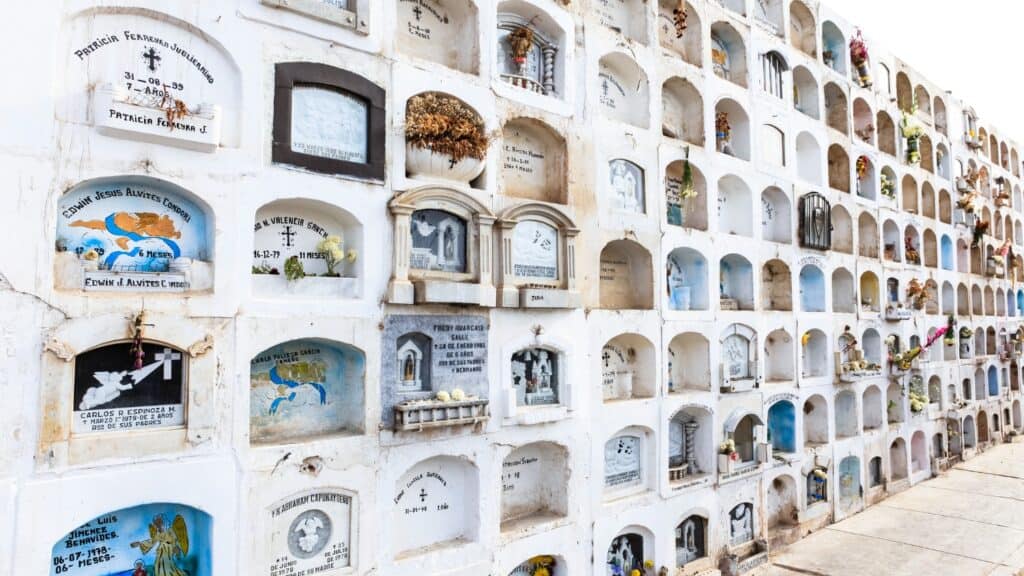
Available in a variety of styles and materials, such as granite, marble, or glass fronts, niches can be personalized with photos and memorabilia. National cemeteries offer free niches, just as they do free graves, to honorably discharged veterans, their spouse, and dependent children.
Scattering Gardens
These are designated areas within a cemetery in which cremated remains can be scattered. Among cemeteries offering such a service is historic Woodlawn Cemetery in Bronx, New York. The cemetery offers communal scattering in a large receptacle known as an ossuary. A bronze name plaque can be placed on a nearby wall to permanently memorialize the deceased.
Water “Burial”
Scattering at sea is a popular request. However, under less-than-optimum conditions, problems such as the cremains “blowing back” on a windy day may ensue. A better option is to place cremated remains inside a biodegradable urn, which will float on the water’s surface for a time. After it drifts below the water’s surface it will begin to biodegrade.
Memorial Reefs
Then there are artificial reefs that sit on the ocean floor. The cremated remains are mixed with concrete, then molded into a “reef ball.” Over time, the structure will mimic a natural reef formation and provide shelter for marine organisms. Bear in mind, such ecological mindedness does not come cheap. Expect to pay between $4,000 – $10,000.
Let’s Have a Conversation:
What is your opinion of cremation? Have you considered this option for yourself? What would you like to happen with your cremated remains? Have you had to make a decision about a loved one’s cremains? What can you share about that experience?
Tags End of Life Planning


This is a timely essay. Last night, my son gave me my portion of my ex-husband‘s cremated remains. It’s in a very nice box and a special bag. I’ve been thinking about what to do. He and I were married for a quarter of a century and had a very happy marriage and a happy divorce because we loved each other, but just couldn’t live together anymore. We should’ve been modern and stay married and lived separately. I have a broad religious outlook, very inclusive, and I believe the spirit is what’s important not the body, but because of this article, I’m now thinking where should I put my share of his remains?
Burial or entombent is definitely not final disposition. For myself scattering in a scattering garden is a prefered option. At least my cremains would end up in fresh air.
I’m surprised this article didn’t discuss the various memorial items that can include cremated remains. Beads, jewelry, ceramic items, sculptures, and many other items can be made using some or all of the cremation ashes. Locks of hair can also be used. A search for “memorial jewelry” or similar can show some options.
In Illinois it is illeigal to scatter a loved ones remains. There is a $10000 fine if caught.
I was very interested in this article since my husband died almost a year ago and his remains were cremated. I also have the cremated remains of a small dog that was more like a two legged family member. To date, my current solution for final disposition is to mingle my ashes along with those of my husband and dog and have them mixed into a reef ball. Since we both really loved crabs and other seafood this seems like a good give back to the ocean. However, plans change so I’m keeping my options open.
Please consider recording the name of the individual and where the ashes have been scattered in cemetery sites such as http://www.findagrave.com and billiongrave.com. Postings are FREE and will assist those interested in genealogy.